
The Scientific American is running a piece on Border Bias.
Essentially noting that political borders matter for decision making in ways that are not entirely rational. Of course, political factors are rational after their own fashion, but requires a different type of thinking - and pol. sci. love borders! (not the bookshop, we shop bookdepository.com.)
The experiment had an(hypothetical) earthquake strike within 200 miles of one's possible new house - one choice of house was in state of the quake and one choice out of state (but both 200 miles from epicenter). Unsurprising people generally chose to be out of state althought the risk of another quake is identical. The authors are surprised.
They should not be. Queensland is going to be doing a lot of budget heavy lifting with knock on effects in education and health due the flood - and if the quake occurs in your state then you suffer these indirect effects which would be better to avoid by being out of state- even if risk of future quakes is identical.
perfectly reasonable really
Showing posts with label Political Economy. Show all posts
Showing posts with label Political Economy. Show all posts
Tuesday, 22 February 2011

Saturday, 19 February 2011
Circle is complete
For those of you who still haven't read Andrew Sheng's From Asian to Global Financial Crisis - get onto it.
Ben Bernanke is now claiming that it is effectively "hot money" Foreign Investment which caused the GFC in the US. This is a photo-stat of Asia's arguement in 1997-8 during their Crisis - which resulted in Asia as a collectively moving away from the washington concensus and capital account liberalization. The US's complaint is ironic, but also helps to explain why a new concensus on capital account liberalization is emerging. Now liberal investment would be great if you can trust the pricing mechanism - the global credit rating agency have proven their useless so amazing that this is unlikely. The irrational bias of investor towards their home market is starting to look pretty sensible.
Quotes
Ben Bernanke - "Foreign investors’ hunger for safe US assets helped to cause the 2007-2009 crisis by encouraging banks to turn risky mortgages into AAA rated bonds, Ben Bernanke, US Federal Reserve chairman, argued in Paris on Friday.
http://www.ft.com/cms/s/0/eea1957c-3b5e-11e0-9970-00144feabdc0.html#axzz1EO1UIahc
Ben Bernanke is now claiming that it is effectively "hot money" Foreign Investment which caused the GFC in the US. This is a photo-stat of Asia's arguement in 1997-8 during their Crisis - which resulted in Asia as a collectively moving away from the washington concensus and capital account liberalization. The US's complaint is ironic, but also helps to explain why a new concensus on capital account liberalization is emerging. Now liberal investment would be great if you can trust the pricing mechanism - the global credit rating agency have proven their useless so amazing that this is unlikely. The irrational bias of investor towards their home market is starting to look pretty sensible.
Quotes
Ben Bernanke - "Foreign investors’ hunger for safe US assets helped to cause the 2007-2009 crisis by encouraging banks to turn risky mortgages into AAA rated bonds, Ben Bernanke, US Federal Reserve chairman, argued in Paris on Friday.
“The preference by so many investors for perceived safety created strong incentives for US financial engineers to develop investment products that ‘transformed’ risky loans into highly rated securities,” said Mr Bernanke, presenting a new research paper that he co-wrote with other Fed economists."
This AMAZING anecdote courtesty of the FT.http://www.ft.com/cms/s/0/eea1957c-3b5e-11e0-9970-00144feabdc0.html#axzz1EO1UIahc
Friday, 18 February 2011
Cross listing,
The Shanghai Stock Exchange and BM&F Bovespa, more on Brazil and China at http://www.eastasiaforum.org/2010/10/28/china-a-motivator-for-latin-america/
this is an interesting story.
Deutsche Börse and NYSE Euronext, with interesting historical parallels. http://www.cfr.org/economics/big-bourse-mergers-back-but-hold-hyperbole/p24112
the London Stock Exchange and Toronto’s TMX Group,
SGX of Singapore and Australia’s ASX are all in takeover talks.
see,
http://www.reuters.com/article/2011/02/14/us-asia-exchanges-idUSTRE71D0Z120110214?pageNumber=2
From: http://www.ft.com/cms/s/0/7c6d8f9a-3a07-11e0-441-00144feabdc0.html#axzz1EFzVNauD
this is an interesting story.
Deutsche Börse and NYSE Euronext, with interesting historical parallels. http://www.cfr.org/economics/big-bourse-mergers-back-but-hold-hyperbole/p24112
the London Stock Exchange and Toronto’s TMX Group,
SGX of Singapore and Australia’s ASX are all in takeover talks.
see,
http://www.reuters.com/article/2011/02/14/us-asia-exchanges-idUSTRE71D0Z120110214?pageNumber=2
From: http://www.ft.com/cms/s/0/7c6d8f9a-3a07-11e0-441-00144feabdc0.html#axzz1EFzVNauD
Thursday, 13 January 2011
Crowding out the government!?
I post this mostly for amusement, but it raises serious questions.
Queensland, and Brisbane (wher eI came from) has been hit by a massive flood - so large that even the BBC news lead with it.
Now there are appeals for people to contribute charity to help rebuild.
Fair enough, but are private contributions really good? Consider, that these are Tax Deductable.
This is therefore the private sector crowding out the public section by reducing federal tax income and increasing the Queensland income. It simply can not be efficient to do this, the charity is fine but making it tax deducable is inappropriate in this case as it will warp rebuilding priorities.
I expect to be a popular man in canberra?
Queensland, and Brisbane (wher eI came from) has been hit by a massive flood - so large that even the BBC news lead with it.
Now there are appeals for people to contribute charity to help rebuild.
Fair enough, but are private contributions really good? Consider, that these are Tax Deductable.
This is therefore the private sector crowding out the public section by reducing federal tax income and increasing the Queensland income. It simply can not be efficient to do this, the charity is fine but making it tax deducable is inappropriate in this case as it will warp rebuilding priorities.
I expect to be a popular man in canberra?
Wednesday, 11 August 2010
Status and Saving
The house-hold saving rate in the US is soaring, up from about 1% prior to the crisis to nearly 6.4% this quarter. Without dwelling too much on whether this is sufficient, the mechanics of why the rate is changing is worth thinking about.
Indeed, a crisis is usually associated with growing debt. No doubt the US government is doing so on behalf of households, but it does not follow necessarily that the household sector saving rate would automatically increase. Indeed, in a globalized world it is possible that US government, firms and households might all opt to save less.
I am beginning to think that house-hold rate increase in the US is only in part a rational response to economic conditions (i.e. increased uncertainty), rather a more sociological phenomena. To whit, people are starting to save as an expression of their status, identity and morality.
Whereas before, as the US became a society of leisure and consumption became a conspicuous marker of status, the new marker of high status is reserved to 'saving.' Saving can be thought of as conspicuous in terms of the goods and services foregone. Saving is now a marker of moral fiber (aka high status) whereas before it was scoffed at. Indeed, as one bank ad claims, "saving is the new spending."
(Quite why a bank is promoting this, and people following another avenue for thought).
Moreover, the new savers are not in general the lower class I imagine - but rather aspirant middle class. These new savers in the US are also likely to be well educated and highly skilled, circumstantial evidence for which might be found below.
My thoughts concluded, saving as a social activity? The concept certainly challenges the rational model and suggests that there is an extra social variable in determining when the US pulls itself out of its current economic problems.
Thursday, 5 August 2010
I dug this chart out of data360 looking for something else, it shows the cost of torts relative to the US economy.
 At nearly 2%, the US has to be the world's most litigious society.
 Australia seems be heading the same way, discussion of tort costs outstripping GDP growth (no evidence on the site). Peter Gordon's blog further quotes from the Fin Review a comparison with other countries (2004);
Denmark 0.4
UK 0.6
France 0.8
Canada 0.8
Japan 0.8
Switzerland 0.9
Spain 1.0
Australia 1.1
Belgium 1.1
Germany 1.3
Italy 1.7
U.S. 1.9
UK 0.6
France 0.8
Canada 0.8
Japan 0.8
Switzerland 0.9
Spain 1.0
Australia 1.1
Belgium 1.1
Germany 1.3
Italy 1.7
U.S. 1.9
Interesting, eh?
Thursday, 22 July 2010
Klassic Krugman: Fed Fail!
An amusing graph by Krugman, with even more amusing assumptions.
It is called the FedFail index, and shows how far core economic indicators (inflation and employment) are from the Fed's targets. It is calculated by "1.3* ABS(unemployment – 5) + 2* ABS(core inflation – 2)." And looks like:
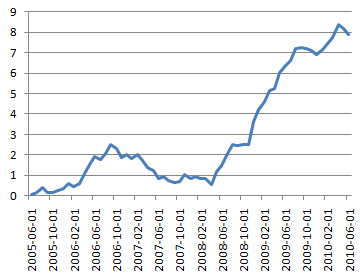
Having read through Rudebusch (San Fran Reserve)'s letter, I understand very roughly were Paul is getting the weightings of 1.3 and 2 for inflation and employment. But there is clearly a value judgement implicit in these weighting - i.e. employment more important than inflation. An unsurprising value judgement given Paul's politics perhaps, but something to be leery of.
Additionally, it is likely that the target for inflation and employment at the Fed has shifted - and it seems clear that they are more interested in reigning in inflation than employment.
If I get truely bored this weekend I might try to knock one of these up for Australia, see how we stack up.
Subscribe to:
Posts (Atom)


 Posts
Posts

